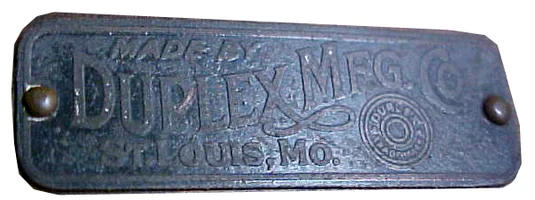
Duplex · Spirit of St. Louis
Duplex Spirit of St. Louis
The Spirit of St. Louis is Duplex's 1930s snare, built the opposite way round to everything else: the heads are 13 inches and the shell is larger than they are, so the tension rods run inside the drum rather than outside it. Dealers describe both cast aluminium and blackened brass shells, the latter with gold rims, clips and rods.
The rods are on the inside
Every other snare drum in this catalogue puts the tension rods outside the shell, where you can reach them with a key and where they are the first thing that gets bent in transit.
The Spirit of St. Louis makes the shell larger in diameter than the heads and runs the rods down the gap between the two. Thirteen-inch heads sitting inside a shell an inch or two bigger, with the hardware hidden in the ring of space that creates.
Nothing else looks like it. From above it reads as a drum sunk into a metal cylinder; from the side the hoops disappear below the shell’s rim and there is no visible tension hardware at all.
That is the same instinct as the 1890s patents — Duplex had spent fifty years asking what a drum has to have on the outside, and kept concluding the answer was less than everyone assumed.
What this does to the sound
An oversized shell around a smaller head is, acoustically, a drum with a collar.
The shell extends past the playing surface on both sides, so the head sits recessed inside a short metal tube rather than at the open end of one. That directs sound outward along the drum’s axis and adds a hard reflective surface immediately around the head’s edge, where a conventional drum has nothing but air.
The rods themselves sit in that space, which also means they are shielded from the stick and from the world. A drum that cannot have its tension rods knocked out of true is a drum that stays in tune between load-ins.
Metal, and which metal
The two dealer descriptions that document this model disagree, and the disagreement is recorded rather than resolved.
One describes a cast aluminium shell 15 inches across; the other a blackened brass shell of 14 inches with eight lugs and gold-finished rims, rim clips and tension rods — the Duplex answer to a Black Beauty.
Both are plausible and they are probably both true. A model built across a decade in a small factory is likely to have been made in more than one metal, and no Duplex catalogue was reachable to settle it. The spec table marks the shell contested and gives both.
Late Duplex
By the time this drum appeared, the company had been making separate tension drums for around forty-five years and the rest of the industry had long since adopted the idea.
The Spirit of St. Louis is what a maker does when its founding innovation has become everybody’s baseline: it went looking for the next structural question rather than competing on finish and fittings. The drums are scarce, they are unmistakable, and they are the last distinctly Duplex thing the company made.
Specifications
| Attribute | Value |
|---|---|
| Shell | |
| Shell material | Cast aluminium1†Also reported as Olympic Drums describes a Duplex Spirit of St. Louis with a blackened brass shell and gold fittings.Two dealers describe the same model in different metals. Both readings are recorded; the model appears to have been built in more than one material. |
| Construction | Shell larger in diameter than the heads, with the tension rods fitted inside the drum1*From a vintage dealer's listing; Duplex published no catalogue reachable for this record. |
| Shell diameter | 15 in1†Also reported as Olympic Drums gives 13 in heads over a 14 in shell.The two dealer descriptions differ by an inch on the shell; both agree the shell is larger than the heads. |
| Shell depth | 7 in2*Olympic Drums gives 7 in; Drugan's lists a 7.5 × 13 example, so depth varied. |
| Finish | Blackened brass shell with gold rims, rim clips and tension rods2*Describes the 'Black Beauty' version; Drugan's example had its wrap removed. |
| Hardware | |
| Lugs | Eight, on the blackened brass example2*From the Olympic Drums listing for one drum, not a catalogue figure. |
| Heads | |
| Head diameter | 13 in1*Both dealer listings agree on 13 in heads. |
| Build | |
| Built | 1929 to 19392*Dating given by the dealer; no Duplex catalogue was reachable to confirm it. |
| Origin | |
| Made in | United States — St. Louis, Missouri1*Duplex operated in St. Louis throughout; see the separate tension snare record for the patents. |
- *Not yet checked against a published source. Where a numbered source is given, it is on record but has not been opened and confirmed. See how we source.
- †Sources disagree on this value; both readings are given.
Sources
Numbered footnotes in the spec table point here.
- 1Tier 2 · Highretailer listing
- 2Tier 2 · Highretailer listing