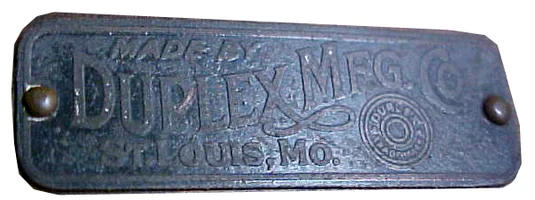
Duplex Separate Tension Snare Drum
The Duplex separate tension snare is the drum Emile Boulanger patented in St. Louis and built from 1883: batter and snare heads tensioned independently through rods running between two hoops, rather than by one rope or one set of rods pulling both. Boulanger's 1887 patent adds a perforated metal shell and a tubular brace hoop at the drum's waist.
What separate tension actually solved
Before it, a snare drum was tensioned by rope: a single cord lacing the two hoops together, with leather ears to take up slack. Tighten the rope and both heads tighten together.
That is a problem, because the two heads want different things. The batter head needs to be firm enough to play on. The snare head — thinner, with the wires against it — needs to be tuned to respond to those wires, and the tension that suits one almost never suits the other.
Separate tension puts a threaded rod between the two hoops with an adjustment at each end, so each head is set on its own. Every modern drum works this way, which is why the innovation is invisible: it won so completely that it stopped being a feature.
Boulanger patented the tension rod in 1883 and Duplex built the drum from that year.
A drum with almost no shell
Read the 1897 patent and what is striking is how little drum there is.
The claim describes two parallel hoops held rigidly apart by posts and tension rods, with the spacing between the heads adjustable. The tubes carrying the rods pass through the posts, and screws driven from inside the drum lock the assembly. The shell, in this construction, is not doing structural work — the hoops and the rods are the drum’s skeleton.
That is a radical piece of thinking for 1893, when the application was filed, and it is the same logic that free-floating shells would be sold on a century later: take the tension off the shell and the shell can do something other than hold the drum together.
The spider
The other claim in the 1897 patent is easy to miss and is the most inventive thing in it.
Hoops held apart only at their rims will flatten — pull hard enough on a circle at discrete points and it goes oval. Boulanger’s answer is a radial spider: rods running out from a central disc to sockets around the hoop, threaded so they can be turned to push the hoop back into a circle, and rubber-covered so they do not transmit vibration.
It is a wheel, essentially, with the hoop as a rim and the rods as adjustable spokes.
The perforated shell
The 1887 patent describes a cylindrical metal shell perforated so that air pressure equalises on both heads, with a tubular brace hoop encircling the drum at its waist carrying the sleeves the tension rods screw into.
A vent hole is standard on every drum now, for exactly this reason: a sealed shell resists the batter head’s movement and chokes the drum. Duplex was designing the solution into the shell as a row of openings rather than as an afterthought.
What it led to
Duplex was the first company to market separate tension drums, and the makers who followed — Ludwig, Leedy, Slingerland — built on a principle it had established and moved past the more extreme parts of its engineering.
The company carried on into the 1930s, by which point it had gone somewhere else entirely with the Spirit of St. Louis. This drum is where it started.
Specifications
| Attribute | Value |
|---|---|
| Shell | |
| Construction | Two hoops held rigidly apart by posts and tension rods, with the spacing between batter and snare heads adjustable3*From Boulanger's 1897 patent specification (US 578,198). A patent describes the invention rather than any particular drum as sold. |
| Shell | Cylindrical metal, perforated to equalise air pressure on both heads2*As described in US 371,415; Duplex drums are found in both wood and metal, so this describes one construction rather than all of them. |
| Hardware | |
| Tensioning | Screw-threaded rods engaging sleeves, drawing the hoops together; the two heads adjust independently2*From Boulanger's 1887 patent specification (US 371,415). |
| Brace hoop | Tubular hoop encircling the drum at its waist, carrying the tension-rod sleeves2*From US 371,415. |
| Stiffening | Radial spider of rubber-covered rods from a central disc, threading into rotatable sockets, to stop the hoops flattening3*From US 578,198; this feature is claimed in the patent and is not present on every surviving Duplex drum. |
| Snare adjustment | Clamp tightened or slackened by turning a half-rod3*From US 578,198. |
| Origin | |
| Made in | United States — St. Louis, Missouri2 |
| model | |
| Introduced | 1883, by Emile Boulanger1*The 1883 tension-rod patent is the earliest of the three; the date Duplex itself gave for the separate tension drum. |
- *Not yet checked against a published source. Where a numbered source is given, it is on record but has not been opened and confirmed. See how we source.
Sources
Numbered footnotes in the spec table point here.
- 1Tier 1 · Primarymanufacturer spec
US Patent 274,900 — New and Improved Tension-Rod for Drum Heads (Emile Boulanger)
- 2Tier 1 · Primarymanufacturer spec
- 3Tier 1 · Primarymanufacturer spec